
The first handstamped postal markings of Egypt are those of the postal system organised by Napoleon Bonaparte during the French occupation of Egypt from 1798 to 1801.
The chronology of the Napoleonic campaign begins with the sailing of a French army from Toulon, the naval base near Marseille, on May 19th 1798. The convoy evaded Admiral Nelson's fleet and arrived off the coast of Egypt on July 1st. Landing commenced immediately at Marabit, west of Alexandria, which was successfully assaulted on July 2nd. The French army proceeded up the Nile to Cairo, reaching it on the 21st; by July 27th Cairo was fully invested.
Nelson's fleet soon discovered the French fleet at anchor in Aboukir Bay, just east of Alexandria, and destroyed it in a battle lasting from August 1st to 2nd, thereby stranding the French army. A landing was not made, however, and the French were left in control of Egypt. They soon spread their control throughout the country, reaching as far south as Assuan, which was captured on February 2nd 1799.
Two attempts by Turkish armies to dislodge the French were unsuccessful, although they reached as far as Heliopolis (March 1800). Bonaparte carried out campaigns into Syria from his Egyptian base, and some of the surviving correspondence deals with these campaigns.
The occupation of Egypt came to an end in 1801. A British force defeated the French near Alexandria in March 1801. Reinforcement by Turkish armies as well as troops from East India led to the surrender of Cairo on July 27th. The city of Alexandria held out until September 2nd. Following these events, the French occupying forces and accompanying civilians were repatriated to France in an orderly manner.
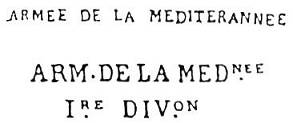
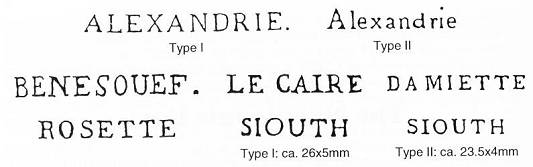
The earliest postal markings associated with the expedition are straight-line army handstamps1 (Fig. 1). The "1re. DIVISION" handstamp is known on letters mailed at Toulon while the expeditionary force was being assembled, as well as on letters written in Cairo in 1798. Post offices were opened in Alexandria and Cairo, followed by about a dozen others, not all of which are known to have had handstamps. The known handstamps are all straight-line types, without indication of date (Fig. 2). Six locations had them (see table below).
There are two types for Alexandria and Siouth2. Type II of Siouth (23.5mm) developed a progressive split in the letter I, causing it to resemble a Y. I have not seen Type I (26mm). Strikes of SIOUTH are often overinked and oily, making measurement difficult, and the appearance of the letters may vary. For this reason the distinction between Type I and Type II is difficult and some students believe them to be from the same handstamp.
Letters are known addressed to Menouf, Mansura, and Samanoud, so those places presumably also had post offices. Some offices are known only as manuscript markings (e.g., Bilbeis). It has been suggested3 that offices may also have existed at Assuan, Qena, Girga, Fayum, Esna, Kosseir, Aboukir, Tanta, and Katieh (Sinai). A letter is known headed "Minia", but bearing a Benesouef handstamp, and one headed "Bilbeis" but handstamped at Cairo.
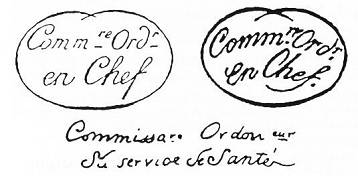
A different sort of handstamp found on some letters consists of a kidney-shaped frame, within which is the inscription, in cursive script, "Commre Ordre / en Chef" (Commissaire Ordonnateure en Chef). There are two types: in one, the inscription is in horizontal lines; in the other, the lines are curved, convex upwards (Fig. 3). These handstamps occur on letters headed at Cairo, and may occur by themselves or accompanied by the LE CAIRE handstamp. Two examples only are known of a third type4.
Most of the strikes of the handstamps are in black, but Benesouef and Siouth are known in red only; Le Caire exists in red, but is rare in that color.
Letters are known throughout the period of the occupation, but the dates can only be determined when the actual letter is included. Fortunately, this is generally the case, for envelopes did not exist at that time, and letters were written on one large sheet of paper, which was then folded up and sealed. The dates shown in the table above are expressed in the Gregorian calendar, although the dates are always written in letters in the Republican calendar, which bears no simple relation to the conventional Gregorian or Julian calendars.
A typical date might be written "le 28 Nivose - an 9". This can be converted to "18th of January, 1801". The base point is September 22nd 1792 (Day 1 of Year 1). Thus "an 9" begins 8 years later, September 22nd 1800. Each month was exactly 30 days (plus 5 festival days in September).
| Vendemiaire: Sept. 22 to Oct. 21 | Germinal: Mar. 21 to Apr. 19 |
| Brumaire: Oct. 22 to Nov. 20 | Floreal: Apr. 20 to May 19 |
| Frimaire: Nov. 21 to Dec. 20 | Prairial: May 20 to June 18 |
| Nivose: Dec. 21 to Jan. 19 | Messidor: June 19 to July 18 |
| Pluviose: Jan. 20 to Feb. 18 | Thermidor: July 19 to Aug. 17 |
| Ventose: Feb. 19 to Mar. 20 | Fructidor: Aug. 18 to Sept. 16 |
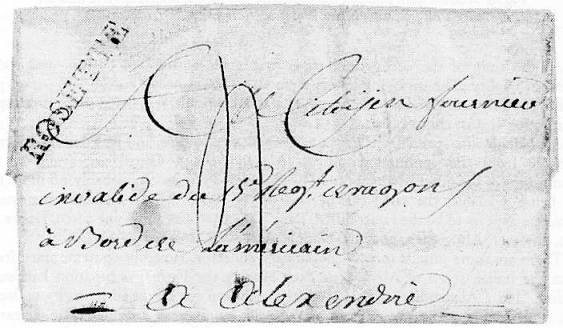
There are usually no rate markings, since most letters were internal mail. Some, however, have manuscript numerals (Fig. 4); "4", "8", and "10" have been seen. The significance is not known, for they can be found on purely military mail. One can speculate that letters were normally prepaid (or were exempt), and needed no rate mark, but unpaid letters might have been marked with the amount due.
Letters for destinations outside Egypt (perhaps invariably France) are rare. The British fleet maintained a blockade, and only small, fast ships could slip through. Mail to France was thus infrequent and fraught with risk. In addition to the handstamp of origin, covers generally bear a French entry mark: "V. D. M. P. Toulon" (voie de mer par Toulon) or VOYE DE MER / PAR MARSEILLE.
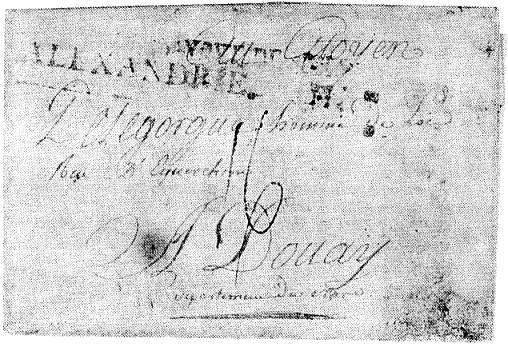
Pitfalls: All Napoleonic covers from Egypt are very scarce to rare. Altogether about 130 Napoleonic covers are known. Beware of letters from the Italian town of Alessandria bearing "108 / Alexandrie", or the Italian town of Cairo. The French used `Le Caire`, never 'Cairo'.
British Forces Mail: When the British forces landed in Egypt in 1801, letters were sent without any handstamps of origin, and can be identified only by the content. They received handstamped markings on arrival in Britain (e.g., SHIP LRE with Falmouth or Plymouth). The dates are 1801 and 1802.